Australia is one of the driest inhabited continents on earth. It is also positioning itself as a major hub for artificial intelligence infrastructure. Those two facts are beginning to collide in ways that water planners, regulators, and industrial operators cannot afford to ignore.
The global conversation about AI’s water footprint has so far been dominated by developments in the United States, where data centres in Arizona, Texas, and the southeast are drawing heavily on already stressed water supplies. But Australia’s exposure to this problem is significant and, in some respects, more acute. The country’s water resources are finite and unevenly distributed. Its climate is variable in ways that make planning difficult. And its data centre sector is expanding at a pace that is only beginning to be measured against the water implications.
A Sector Growing Faster Than Its Planning
Australia’s data centre market has grown dramatically over the past two decades. Total deployable capacity expanded from around 37 megawatts in 2005 to 1.3 gigawatts in 2025, a forty-fold increase driven first by cloud computing and then accelerated sharply by AI demand. That capacity is projected to more than double again by 2030, with around AU$26 billion in new investment already committed or in the pipeline.
The scale of international investment is considerable. Amazon Web Services has pledged AU$20 billion between 2025 and 2029, while Microsoft committed AU$5 billion to expand its footprint across Sydney, Melbourne, and Canberra. Sydney and Melbourne together house about 80% of the country’s data centre capacity, with global players like Equinix and local operators like AirTrunk, NEXTDC, and CDC rapidly strengthening their positions.
The water implications of this expansion are only recently coming into focus. A Reuters investigation published in September 2025 found that the New South Wales state government had approved all ten data centre applications it had ruled on since expanding its planning powers in 2021, with fewer than half of those applications giving projections of how much water they would save using alternative sources. The same investigation found that the approved centres would collectively use up to 9.6 gigalitres of clean water per year, or nearly 2% of Sydney’s maximum supply.
That figure is set to grow. Sydney Water projections suggest data centres could account for up to a quarter of Sydney’s available water by 2035, or 135 gigalitres. Sydney’s drinking water relies on a single dam and a desalination plant, and the city has already experienced water restrictions severe enough that residents were banned from watering gardens or washing cars during the droughts of 2019.
Australia’s Water Situation Is Not a Background Detail
The water stress that makes this expansion so consequential is not a future risk. It is an existing condition across much of Australia, and one that is likely to worsen as the climate shifts.
Australia’s rainfall is highly variable and unevenly distributed. The inland regions that host significant mining and agricultural activity receive far less rainfall than the coastal cities, and even those cities face long-term supply constraints. Research by MSCI, which analysed roughly 14,000 data centre assets globally, identified Australia among the countries where existing data centre facilities are most likely to face increased water scarcity conditions by 2050, alongside Chile, Brazil, Mexico, and Turkey.
State and federal water ministers have already named data centres as an emerging threat to water security. The Senate launched a formal inquiry into artificial intelligence and data centres in May 2026, with the Committee directed to examine whether existing Commonwealth, state, and territory frameworks covering planning, environmental, energy, and water regulation are keeping pace with the scale and speed of data centre growth.
Australia’s National AI Plan, released in December 2025, has been criticised for giving little focus to water and energy. The gap between the ambition of Australia’s AI infrastructure agenda and the practical water planning required to support it is real, and it is beginning to attract the kind of scrutiny that tends to precede harder regulatory requirements.
What Data Centres Do to Local Water
The mechanism by which data centres consume water is worth understanding clearly, because it shapes what kinds of solutions are actually available.
Most large data centres use evaporative cooling to manage the heat generated by their servers. In this process, water is circulated through cooling towers where it absorbs heat and is then vented as water vapour. That water is permanently lost from the local supply. It is not discharged to a waterway or treated and returned. It evaporates, and the volume has to be continuously replaced from the municipal network or an alternative source.
In Sydney, single data centres are applying to Sydney Water for connections that would use up to 40 million litres per day, equivalent to 16 Olympic swimming pools, though the industry notes that facilities rarely require the maximum water capacity they apply for. Even at a fraction of that rate, the cumulative draw of dozens of facilities operating simultaneously is substantial.
Water demand from Sydney’s data centre sector is projected to grow to around 1.9% of the city’s total supply by 2030, and to 0.9% of Melbourne’s. Those percentages may sound modest in isolation, but they sit on top of existing supply pressures, and they are growing at a rate that water planners have not previously had to account for.
The Industries That Have Already Solved This
The data centre sector is encountering a version of a problem that other Australian industries have been managing for decades. Mining and resources operations in Western Australia and the Northern Territory have long operated in environments where municipal water supply is simply not available. Water has to be sourced, treated, managed, and where possible reused entirely within the bounds of the project site.
That reality has driven the development of water management expertise in Australia’s industrial sector that is directly relevant to the challenges now facing data centre operators. Remote mine sites routinely manage potable water supply, process water treatment to precise quality specifications, and wastewater treatment and reuse, all in locations with no connection to urban infrastructure and subject to strict environmental discharge requirements.
The disciplines involved, closed-loop water systems, treatment to specification, on-site reuse, minimal discharge, are structurally identical to what data centre operators will need to implement as regulatory and community pressure increases. The difference is that the industrial sector built these capabilities out of operational necessity, while the data centre sector is only now beginning to recognise that it will be held to similar standards.
Operating Without a Safety Net: ABCO Water
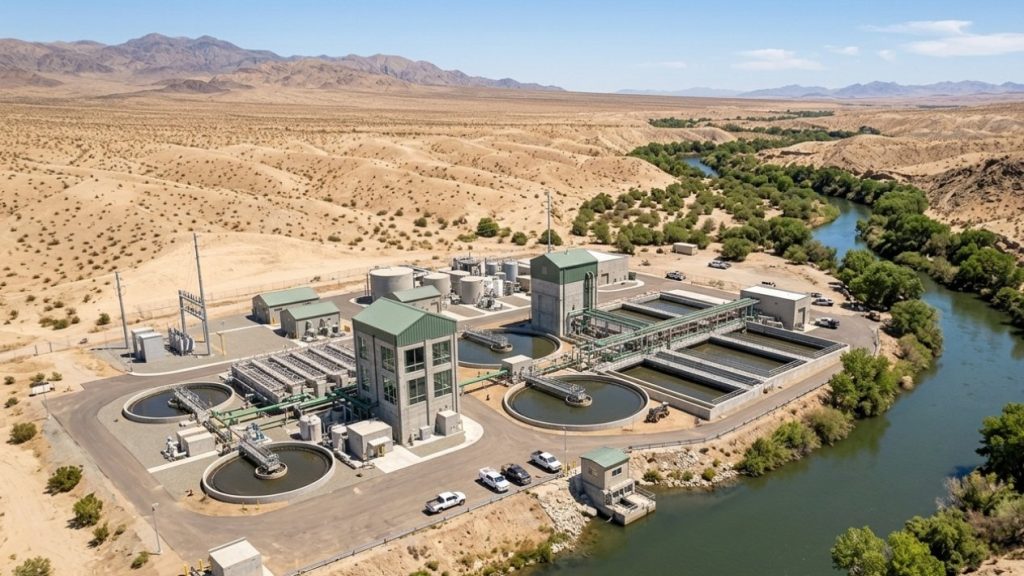
ABCO Water has spent decades delivering water and wastewater treatment systems in the kind of environments where water scarcity is not a policy discussion but an operational reality.
Their project portfolio does not include urban or peri-urban sites with easy access to municipal supply. It includes a rare earths project located 135 kilometres from Alice Springs in the Northern Territory, where both potable water and wastewater treatment had to be delivered in one of Australia’s most arid environments, with no surrounding infrastructure to fall back on. It includes a remote road construction camp near the WA/NT border, where an 86-person workforce required reliable potable water and wastewater management in conditions that would simply not support an off-site solution. It includes a garnet mining operation near Kalbarri in Western Australia, where process water had to meet an electrical conductivity specification of less than 30 µS/cm for final product washing, precision water treatment in a water-limited coastal environment.
What each of these projects shares is an operating model built around scarcity. When there is no municipal network to draw on and no waterway to discharge to, water management stops being a compliance checkbox and becomes a core engineering problem. Sourcing, treating, reusing, and minimising loss are not aspirational targets. They are the conditions of operation.
That is precisely the kind of thinking that Australia’s data centre sector is going to need as it scales into a country where water is not an assumed utility.
What Comes Next
The regulatory environment around data centres and water is changing. The Senate inquiry launched in May 2026 is explicitly examining whether existing frameworks are adequate, and the signs are that they are not. Planning approvals that did not require measurable water reduction plans are unlikely to be the standard for much longer. Water utilities are already signalling that supply cannot keep pace with the volume of connection requests they are receiving from the sector.
The industries best placed to navigate what comes next are those that have not waited for regulation to prompt them to think carefully about water. Australia has deep expertise in arid and remote water management, developed over decades of operating in conditions that left no room for complacency. That expertise sits in the industrial and resources sector, in companies that have been solving the same problems the data centre industry is only beginning to confront.
The question is not whether Australian data centres will face harder water requirements. It is whether the sector engages with the available expertise early enough to build water management into its infrastructure from the start, rather than retrofitting solutions after the fact.